
How to read buyer and seller volume pressure
Volume pressure measures how hard each side is pushing right now. It counts the contracts traded by aggressive buyers and aggressive sellers over a short, recent window and compares them with what is normal.
Aggressive volume, split by side
Each trade happens either at the offer, when a buyer crosses the spread, or at the bid, when a seller does. Adding up the contracts on each side over the last few seconds gives two numbers: buying pressure and selling pressure.
A short window matters. Session totals show who has been busier all day, but they move slowly. Over the last 10 seconds, you can see a push start, build and fade.
Compared with normal
Two hundred contracts in ten seconds can be heavy at lunchtime and ordinary at the open. Pressure is more useful when it is measured against what is normal for the instrument and the time of day. A clear way to show that is a threshold mark, for example at twice the normal rate, so a bar that crosses it stands out as a real push.
How to read it
- One bar well past normal and the other small: one side is clearly pushing.
- Both bars high: a fight, with heavy trading on both sides.
- Both bars low: a quiet market, where pushes mean less.
- A bar that peaks and then shrinks while price stops moving: the push may be running out.
Where it misleads
Pressure on its own says who is trading, not whether it is working. Heavy selling with price going nowhere is not weakness: it is often absorption. That is why pressure is best read next to the price move it produced, which is the idea behind effort versus result.
How Delphi Pulse shows it
Delphi Pulse shows seller and buyer pressure as two bars for the last 10 seconds, in contracts with short numbers like 2.5k. A white mark shows heavy flow, and the bars dim when the market is quiet. ES and NQ sit side by side, so you can see whether both indexes are pushing the same way and which started first.
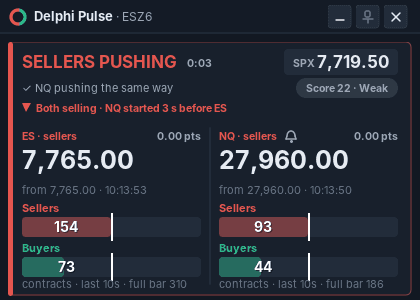
Rendered from a replay with sample prices, to explain how the add-on works. Not a trade result.
Learn about Delphi PulseMore order flow guides
What is absorption in order flow?
Absorption is when aggressive orders keep hitting a price and it does not move. Learn how to spot it, why it matters and how to tell it apart from a push that works.
Effort versus result in order flow
Effort versus result compares how much volume a push takes with how far price moves. Learn how it separates pushes that move price from pushes that stall or get absorbed.
Sweeps and big lots in order flow
A sweep is an aggressive order that trades through several prices at once; a big lot is a single trade far larger than usual. Learn how to read both in futures order flow.
ES vs NQ: which index is leading?
ES and NQ usually move together, so it matters when one pushes and the other does not. Learn how to compare their order flow and read which index started first.
Reading ES order flow for SPX 0DTE options
SPX has no order book of its own, but ES futures do. Learn how SPX 0DTE options traders use ES order flow and how to convert ES prices to SPX levels.
This guide is for educational purposes only, about how markets trade and how an analysis tool displays it. It is not financial advice and does not recommend buying or selling any futures or options contract. Trading futures and options involves substantial risk, and losses can exceed the amount committed. See the Terms of Service.