
Reading ES order flow for SPX 0DTE options
Traders in same-day SPX options (0DTE) watch the S&P 500 index, but the index itself does not trade. The order flow behind it lives in the ES future, which is why many SPX traders read ES to see who is pushing.
Why ES and not SPX
SPX is a calculated index: its value comes from the prices of 500 stocks, so there is no SPX order book, no bid and ask volume, and no aggressive buyers or sellers to watch. ES, the E-mini S&P 500 future, tracks the same index and trades on its own order book almost around the clock.
Because ES and SPX move together, a push in ES order flow shows up in SPX within moments. Reading ES gives an SPX options trader a view of the pressure behind the index.
The ES − SPX difference
ES does not trade at the same price as SPX. The future usually sits above the index by an amount that reflects interest rates and dividends until the contract expires, and that gap shrinks as expiry gets closer. It also moves a little during the day.
To turn an ES price into an SPX level, subtract the current difference. With ES at 7,765.75 and a difference of 45.50, SPX is about 7,720.25. Checking the difference at the start of each session, or whenever it drifts, keeps the conversion honest.
How to use it
- Mark your SPX levels, then convert them to ES with the same difference so you know where to watch the order flow.
- Watch pressure and the price result in ES as it reaches those levels.
- Read the result back in SPX, the market your options are priced on.
- Update the difference each day; a value from yesterday can be several points off.
Limits
The conversion is an estimate. The difference changes over time, and fast markets can briefly pull ES and SPX apart. Option prices also depend on volatility and time, not only on where SPX is. ES order flow is context for an SPX trade, not a prediction of it.
How Delphi Pulse shows it
Delphi Pulse shows the SPX price in a box at the top right: the ES price minus the ES − SPX difference you type in by clicking the box. If the difference was set on an earlier day, the box turns amber as a reminder to update it.
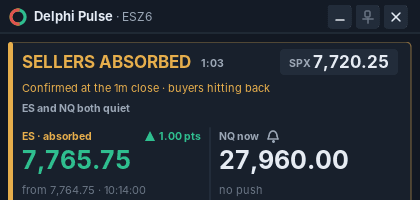
Rendered from a replay with sample prices, to explain how the add-on works. Not a trade result.
Learn about Delphi PulseMore order flow guides
What is absorption in order flow?
Absorption is when aggressive orders keep hitting a price and it does not move. Learn how to spot it, why it matters and how to tell it apart from a push that works.
How to read buyer and seller volume pressure
Volume pressure measures how much aggressive buying and selling is trading right now compared with normal. Learn what it shows, how to read it and where it misleads.
Effort versus result in order flow
Effort versus result compares how much volume a push takes with how far price moves. Learn how it separates pushes that move price from pushes that stall or get absorbed.
Sweeps and big lots in order flow
A sweep is an aggressive order that trades through several prices at once; a big lot is a single trade far larger than usual. Learn how to read both in futures order flow.
ES vs NQ: which index is leading?
ES and NQ usually move together, so it matters when one pushes and the other does not. Learn how to compare their order flow and read which index started first.
This guide is for educational purposes only, about how markets trade and how an analysis tool displays it. It is not financial advice and does not recommend buying or selling any futures or options contract. Trading futures and options involves substantial risk, and losses can exceed the amount committed. See the Terms of Service.