
ES vs NQ: which index is leading?
The S&P 500 future (ES) and the Nasdaq 100 future (NQ) are traded by many of the same participants and usually move together. Because of that, the moments when they disagree, or when one clearly moves first, are worth noticing.
Why compare the two
A push in ES that NQ joins is backed by both of the largest US index futures. A push in ES that NQ ignores is narrower: it may be about a few large S&P names, or about one participant, rather than about the whole market.
Looking at the order flow of both side by side, not just their prices, shows whether the same side is aggressive in each market at the same time.
Which started first
When both indexes push the same way, one usually starts a few seconds before the other. NQ is more sensitive to large technology stocks and often reacts first to news that moves them; ES can lead when the move is broader. Noting which index started the push tells you where the pressure is coming from.
How to read it
- Both pushing the same way: the move has broad participation.
- One pushing, the other quiet: the move is narrower and may have less behind it.
- Pushing in opposite directions: a divergence, often a sign of rotation between sectors rather than a clear market direction.
- Both quiet: there is no push to compare.
Keep it in context
Index agreement is supporting evidence. ES and NQ can disagree for a while and then line up again, and a push both join can still stall. Read it together with pressure and the price result in the instrument you trade.
How Delphi Pulse shows it
Delphi Pulse shows ES and NQ side by side, each with its own price and seller and buyer pressure. A line under the headline says whether NQ is pushing the same way, and which index started first and by how many seconds. An optional alarm can sound when the other index starts a push first.
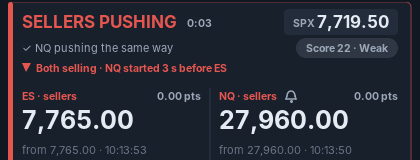
Rendered from a replay with sample prices, to explain how the add-on works. Not a trade result.
Learn about Delphi PulseMore order flow guides
What is absorption in order flow?
Absorption is when aggressive orders keep hitting a price and it does not move. Learn how to spot it, why it matters and how to tell it apart from a push that works.
How to read buyer and seller volume pressure
Volume pressure measures how much aggressive buying and selling is trading right now compared with normal. Learn what it shows, how to read it and where it misleads.
Effort versus result in order flow
Effort versus result compares how much volume a push takes with how far price moves. Learn how it separates pushes that move price from pushes that stall or get absorbed.
Sweeps and big lots in order flow
A sweep is an aggressive order that trades through several prices at once; a big lot is a single trade far larger than usual. Learn how to read both in futures order flow.
Reading ES order flow for SPX 0DTE options
SPX has no order book of its own, but ES futures do. Learn how SPX 0DTE options traders use ES order flow and how to convert ES prices to SPX levels.
This guide is for educational purposes only, about how markets trade and how an analysis tool displays it. It is not financial advice and does not recommend buying or selling any futures or options contract. Trading futures and options involves substantial risk, and losses can exceed the amount committed. See the Terms of Service.